By Cat Jones
I was lost, once, on a long wander through the underworld. I have no idea how I would ever depict that time in words. But today, in a sweltering apartment in the middle of a hot, New York, pandemic summer, one little piece of it comes drifting back to me. Sitting here, in front of my window, trying to think how to bake bread without having to turn the oven on, well something about it has me drifting back in time, to the winter of 2012, and Sarah’s bread. All that bread.
Sarah was a friend of mine. She lived on the same, weird, improbable Island that I did, in the year of the End of the World. This island took the form of an enormous, old, building back in Portland that had once been a Baptist nursing home for more than a century, until some time back in the 80s, when a terrible flu came blazing through, killing dozens of people there in a single, horrendous week. The nursing home was shut down over that carnage, left for dead awhile, alone with its restless ghosts.
By the time I came there, though, bedraggled and broken, and just crawling in off the streets, it had been converted to “artist housing,” which is to say that it was a run-down, sub-standard SRO owned by a greedy developer, an absentee landlord hoping to cash in on other people’s labor. It wasn’t the greedy developer, though, who made it what it was. It was the people who lived there. A hundred creative, beautiful, impoverished artists, as broken and bedraggled as I was, were already stranded there when I washed up on shore. They were waiting for me in its cavernous halls and cramped rooms. Together, we ignored the asbestos and the lead, the lack of hot water most of the time, the funky communal bathrooms, and the drafts. Together, we befriended the Flu Ghosts and wove a colorful tapestry of psychedelic abandon in those tiny rooms and hidden stairwells and winding hallways.
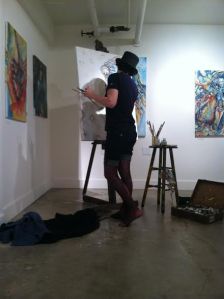
In the basement of the building, in what had once been the hospital chapel, a stage had been built where a little, island theater company put on Shakespearean plays for us all. In the summertime, they performed for free, outdoors in a courtyard in the center of the building, for the entire community. There were two galleries on the first floor, where we held monthly exhibitions, and the entire place was festooned with art. All of the walls lining all the hallways, were filled with paintings. Every wall was covered, every doorway sprouting art. Installations of all kinds squatted in alcoves and covered the grounds. The upper floors each had a communal kitchen, and sometimes we would cook there, but mostly we would gather in the evenings in those kitchens over short cases and tall boys, collectively working on our various projects, talking shit, laughing, playing music, and often enacting dramas of our own.
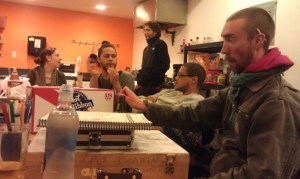
Sarah was an inmate there, same as I was. She had dreadlocks that probably reached down past her knees, though I only ever remember them wound in a great ball, an enormous knot precariously balanced on her head, often wrapped round with pieces of colorful cloth. She had a soft, quiet voice, and often delivered soothing sermons from beneath half-lidded eyes, and before I get to the story of her bread, I will tell you some of the things I remember about Sarah.
She was full of warmth and hippie wisdom. She introduced me to ecstatic dance, and she and I and another friend used to wrap ourselves in whatever beads and streamers and colorful cloth we could dig out of the free boxes there, and go off together to dance and play the drums. She was among the little group of friends who used to come and sit on the floor of my room with me, and we would talk late into the night. I cannot for the life of me remember much of what we said. I do recall that she pointed out a horse I did not know was there, in the corner of a painting I was working on at the time – Salvia Divinorum (a visual record of an entheogenic journey I went on once, looking for my lover who had died earlier that terrible year). (That part is another story, never far removed from me, told elsewhere.) I made it more pronounced after she pointed it out, and every time I see that horse I think of her.
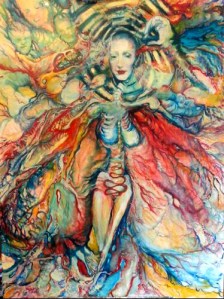
30 x 40″.
Oil on canvas.
Sarah found a horse.
I remember the time she wandered dreamily into the crowded second floor kitchen once, flushed and smiling a faraway smile, and leaned against a wall. Her smile was beatific. “David worshipped my Yoni for three hours,” she joyfully announced, in her glowing voice, to no one in particular. There was something of a stunned silence for a moment, and then finally, “Right ON,” someone said. It wasn’t the kind of conversation one usually expects in the outside world, but neither was it anything all that shocking on that leaky pirate ship on the edge of oblivion.
I remember her sage, her spells, her crystals, and her incense.
I remember Sarah’s womb. That happened the month after I moved in there. Everyone was getting ready for the First Friday show, a thing we did together every month, and people were creating installations all over the building. Sarah had been awarded space in the front entry hall, to bring to fruition a proposal she had submitted, to build a womb in the doorway that people would pass through on their way in and out of the building. She was somehow going to weave it together with long branches from trees that had been cut down, up in the Cascadian forest. She had them all piled in the halls near the entrance for weeks, but, with less than a week to go before the show, she still had not started putting it all together. Her friends became concerned, and it was the only time I ever remember Sarah seeming overwhelmed. She said that she didn’t see how she could pull this off.
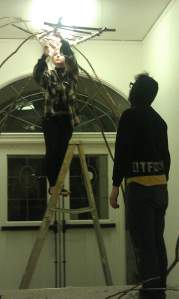
Frankly, I didn’t either, but I wanted to help. So did our friend Wallace. So, one night, we got ladders and tools, and Wallace and I mostly just stood around trying to be supportive while Sarah made some kind of a lean-to out of the branches. She asked the women there who had given birth if we had birthing photos she could use. I offered her some of mine, thinking they would be part of a collective exhibit, but I guess I was the only one who wanted to share such an intimacy with her. (I remember being a little taken aback to see the completed exhibit, that it was only me up there, exposed along the wall for anyone coming or going through that door.) She got it done, though, just in time for the show.
Sarah made more sense than anyone I knew then, full of wisdom. (Though her medical advice turned out to be somewhat suspect, as we discovered when she brought Wallace into the third floor kitchen and tried to treat a boil on his thigh with a scalding hot bottle for some reason. She swore she thought it would work. It didn’t, though.) That was an anomaly, because usually, her wisdom was right on. So I was surprised when Wallace told me one night that she “wasn’t doing well,” and indicated that she was struggling with severe mental illness. I had never seen any sign of it.
She was, though, and only shared her struggle with her closest confidantes.
She was hearing voices. She believed an old pickup truck, perpetually parked on the street outside her window, was possessed, was there waiting for her, and she was afraid of it. She often shared dramatic stories of its malevolence, as matter-of-factly as she had shared David’s generous attentiveness to her Yoni. She heard secret messages and spells in the plays being put on by the theater cast, which she would sometimes describe with the same gentle, meaningful smile with which she imparted all of her social graces.
Sometimes, I was surprised by the fluidity there was, between her lucid and her lost moments. But whatever was flowing from her consciousness in whatever moment, Sarah never once seemed “crazy” to me, whatever that means anyway. She was as much One of Us, there on that lost Island, as anyone else there. We shared a lot together.
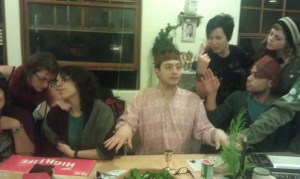
And one of the things I remember about Sarah – anyone who lived there then would also – was all that bread.
Sarah did not believe anyone should go hungry, nor did she believe in wasting food in a world awash in waste. She volunteered with Food Not Bombs, and she engaged in the perpetual, Portland, anarchist art of dumpstering. For some reason, she rarely brought home fruits or vegetables, but every other day or so, she would bring in bread. Lots, and lots, of bread. It’s a thing that bakeries generally only keep the bread they bake for a day, and toss whatever didn’t sell in the evening. There are a lot of bakeries in Portland, and I believe she visited all of them, night after night, lifting the loaves from the bins out back, gathering them in her great pack, and bringing it all to the communal kitchens back on the Island.
That bread helped me a lot that year, because I wasn’t eating much else. Still, it was a LOT of bread. Although there were a hundred artists living there, it was more bread than anyone could eat. It would pile up on the tables, or the counter tops. A few people started complaining about it all, which I thought was impolite and unnecessary. Being starving artists, I was certain we could find some creative use for all of it.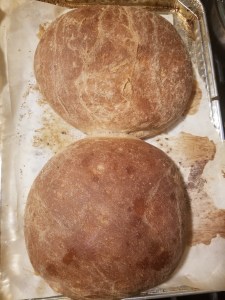
So… we set about trying. I remember wracking my mind and every book on my shelf to find ways to use that bread. I mean, every possible kind of sandwich and toast. Bread crumbs for casseroles. Bread pudding. Someone actually came up with the idea of carving bird houses out of it, and by god it worked! (Stale bread is surprisingly hardy as a carved medium, and it held up well when hung under an eave or something to protect it from the rain.)(When it got wet, though… it was an evolving work of horrendous commentary on our efforts at resourcefulness.)
We tried, half heartedly, to make wheat paste with it, but our first attempt did not succeed and nobody had the sustained interest to try again.
It was owing to Sarah’s bread that I learned to make Kvas that year, which was a very handy thing in a building full of drunken artists and stale bread, but not a lot of money. I had never even heard of this beverage before, and I don’t know why it isn’t more of a thing! It’s a Russian alcoholic beverage made with stale bread and water. What could be more resourceful than that? (I made bottles and bottles of both Kvas and Kombucha in those kitchens.)
So here I am now, 7 years and a lifetime later, in this sultry, pandemic summer, when we are all trying to be resourceful about meeting our needs with whatever we have, and Sarah, the flu ghosts, and all that bread, come back to mind.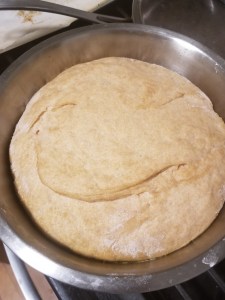
I remember Sarah leaving, too. One night, she invited me down to her room, for a ritual, she said. (There were many of those.) I was feeling down, and not in a mood to socialize, so I didn’t go. I did not realize the significance, or I surely would have. The next day, I found a note from her stuck in my door, saying goodbye and telling me to go down to her room and take anything I wanted.
With some trepidation, I descended the stairs to the floor just below mine. Her little room had been abandoned. She had scribbled long, strange, lines of poetry and prose up the walls and across the ceiling, and around the room in black sharpie ink. I don’t remember what any of it said, only that Wallace and I had stared in silent astonishment at the black web of words, wanting it to say more. There were pools of melted wax clinging to an empty shelf, from candles that had seen her out. She had never had a lot, but everything she had, she’d piled neatly in the center of the room, with instructions to us to take it all. Her little tea pot, some books, a few curios… I don’t remember what all was there. I did not take anything.
Some time in the night, she’d said her goodbyes to the demonic truck, and disappeared out through the trees. I never saw her again. I left the Island shortly after she did, and fled to the east. I still corresponded with Wallace now and then, and a few years after I moved away I asked him if he knew what had ever happened to her. He told me that she had died years before, not long after ditching off the Island. He didn’t realize I hadn’t heard, did not know what had happened to her, and I have never learned anything more. (If this story about those times ever reaches anyone who knows anything more, please do drop me a line.)
[Edit: Shortly after I published this essay, I reached out, again, to friends who were there, to help me figure out where the broken threads of this story went. It has finally been confirmed that it was, indeed, suicide that took Sarah. I’ve always known it was, and that’s how it’s always come out in my writing about that time. But I never knew it for sure, until now. I imagine she went into the trees, and that she did it right after leaving that night. I’ve always, somehow, known that that was her goodbye, and that I should have gone down there to her room the night before she left. Maybe I could have changed her mind.]
Anyway. So that is the story of Sarah’s bread.
It was a strange time, and I sometimes think I dreamed that entire year and everything that ever came before it. But every now and then, someone I knew then comes dreamily into my kitchen, even now.

[I’ve written a couple of other things about that time, and about both Sarah and Wallace in particular, in case you are interested. You can find those stories here and here, should you want to read any more regarding the Year of the End of the World. Wallace is gone now too. He died of an overdose in 2017, having left the world early as he’d always said he would. I learned of his death a few days after it happened, not long after learning of hers. I was in the middle of trying to paint her portrait when I heard. The second link here is a cartoon goodbye to him. I’m pretty sure he would have appreciated it, but who knows.]

 From a Pilgrim on the Road